
Three Ways to Dry Rose Hips for Tea
This article contains affiliate links. As an Amazon Associate, I earn from qualifying purchases.
Tips for foraging, drying, and making rose hip tea, including three ways to dry them and instructions for brewing them in a teapot. Rose hips appear on rose bushes and throughout hedgerows in late summer and autumn and have a delicious fruity flavor. They are also an excellent source of vitamin C!

It’s that time of year again, and the hedgerows are practically heaving with fruit. With most people intent on collecting juicy blackberries or elderberries, the bright red but rock-hard rose hip is often overlooked. Rose hips are the fruit of the rose bush, and you can see them in the summer as a swollen green part of the stem just underneath the flower. In autumn, they swell into a beautiful red ‘hip’ that looks stunning on the bush. They’re also delicious dried and made into vitamin C-rich tea.
Every rose left uncut will eventually produce a hip, but depending on the species, some appear in summer and others later in autumn. To my knowledge, all rose hips are edible, though some varieties have better flavor than others. While many people are familiar with making rosehip syrup, it takes a lot of sugar. For a healthier alternative, simply dry rose hips for tea.
Rose-hip Tea is Rich in Vitamin C
Blessed with a delicate fruity taste and rich in vitamins A, B, and C, rose hips can be used to make all kinds of things. Jellies, syrups, teas, wine, and even skincare. Rosehip oil is especially great for skin that needs rejuvenating!
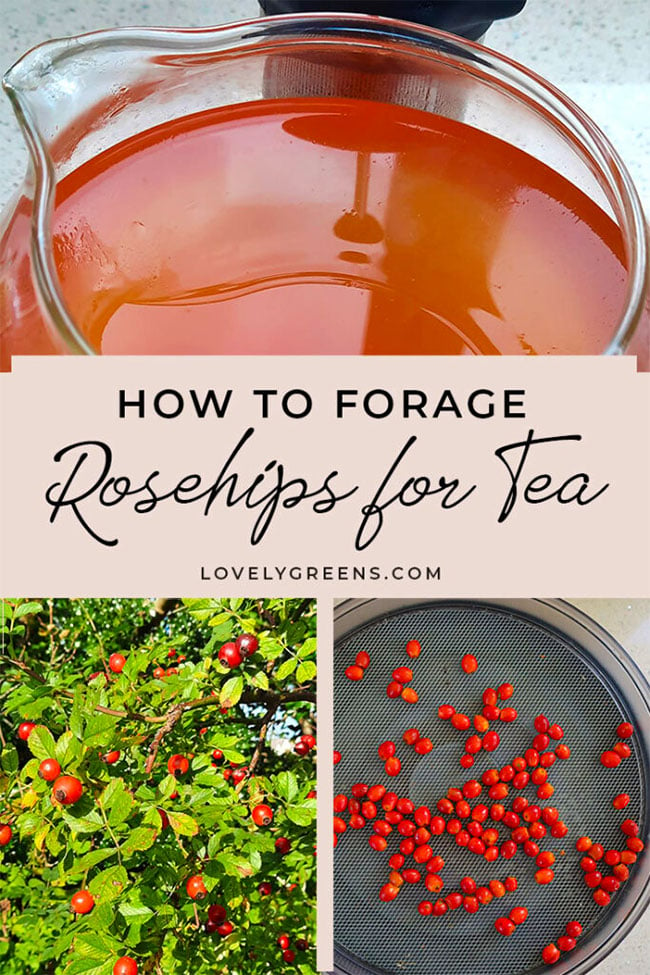
Although all rose hips are good for tea, the best ones are hips from the common wild rose, also known as the Dog Rose, Rosa canina. They’re firm, deep red hips that are rich in flavor and easy to find and harvest. Rosehips are ready to pick in autumn, but the common advice is to harvest them directly after a frost since it’s supposed to improve their flavor.

I usually pick well before truly cold weather, though, and they’re perfectly fine. When picking, choose ones that are firm and vibrantly colored. If you find any that are going soft or have dark spots, pass them by.

The Japanese rose, Rosa rugosa, is another common rose that produces edible, gigantic hips. Literally four or five times the size of a dog rosehip. You can often find them growing in municipal plantings here on the Isle of Man. I like to err on the cautious side and remove as much as possible from inside these hips before drying them.

Drying Rose Hips for Tea
You can dry smaller hips, like those from the Dog Rose, but the larger ones, such as Rosa rugosa, have a lot of hair inside. Rose hips are extremely nutritious, but they contain irritating rose hip hairs inside. Don’t worry, though; you can filter them out before or after drying.

To dry rose hips, first rinse them with water, then let them dry. If you’re using Rosa rugosa hips, it’s best to cut them open and remove as many seeds and hairs as possible. If you’ve picked smaller rose hips, snip the top and bottom off and leave them fairly intact.
Dry Rosehips in the Oven
There are three main ways to dry rosehips: in the oven, in a food dehydrator, or by air drying. Drying in the oven or a food dehydrator is a good option if your humidity is high or the weather is dull and gray. Air drying uses less energy but takes more time; if you have a warm greenhouse or space in the house, it may be the best option.

To dry rose hips in the oven, spread them thinly on a tray and bake at low heat for about three and a half hours, until they’re bone dry. Prop the oven door open a crack with a tea towel or oven mitt so moisture can escape.
Food Dehydrator Method
Drying rose hips in a food dehydrator is far easier and uses less energy than in an oven. Pick your rose hips, rinse them with cool water, and allow them to dry. Prepare as described in step one above and then place them in a thin layer on the racks of your food dehydrator. Dehydrate until bone dry. Cool and store as described above.

Air Drying Rose Hips
There are two ways of air-drying rose hips. If the weather is warm and dry, you can first clean the hips and spread them on waxed paper or screens. The sun can dry smaller hips or pieces of hips in as little as a day. If they’re not completely dry, take the hips inside overnight and put them out again the next day. If you have a greenhouse or polytunnel, you can dry them inside and leave them in overnight.

You can also dry rose hips inside. It takes around a month, but it’s a good option if you’re pinched for outdoor space or the weather isn’t great. Clean and spread them on screens, racks, or wax paper-lined trays, then leave them somewhere dry and well-ventilated. When they’re completely dry, you can store them in jars.
Storing Dried Rosehips
Whichever way you dry rosehips, let them cool completely before storing. The hips can be quite large at this point, though, so I tend to run dried rosehips through a food processor until they’re roughly chopped. Then I pour the chopped rosehips into a fine mesh strainer and shake the ‘itching powder‘ out onto newspaper or into a bag. You’ll be amazed at how easily they fall through the mesh.
You can, of course, skip the food processor step, especially if you’ve dried small rose hips. They’ll make perfectly delicious tea even if you don’t chop them. Pulsing dried rosehips into a finer texture increases the surface area, so you can use fewer rosehips when you make tea. It’s also easier to mix with other herbs when making herbal tea infusions.
When you’re sure the pieces are bone-dry, cool, and the size you want, store rosehips in an airtight container in a dark, cool place until you’re ready to make rosehip tea. Dried rosehips are best used within a year but can last longer depending on how well they’re stored.
Making Rose Hip Tea
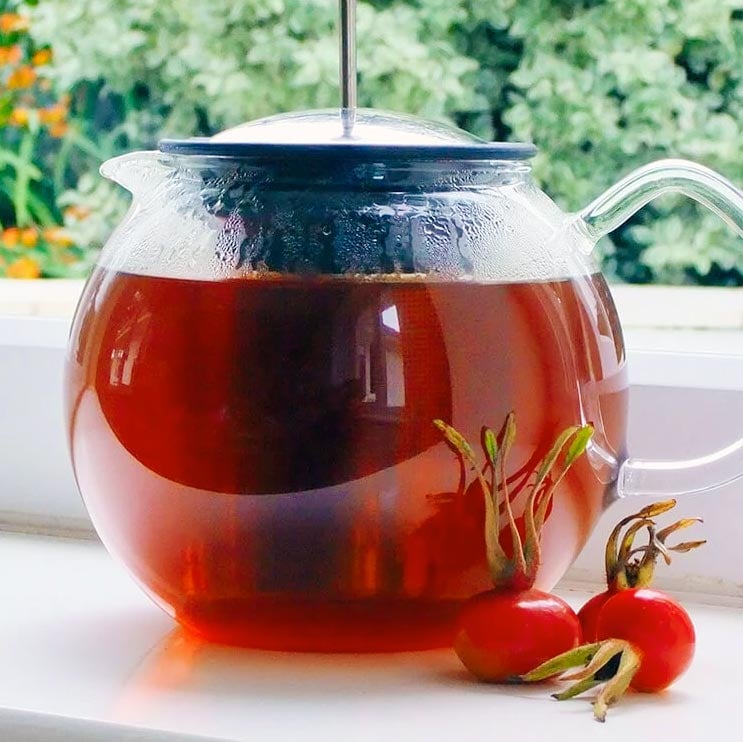
Measure out 1 teaspoon of dried rose hips for each cup of tea you’re going to make. Pour scalding water over the hips and leave to infuse for about five minutes. Remove the tea leaf holder from your teapot and discard the contents. Rosehip tea tends to be orange, but can be red to reddish-brown. Enjoy your vitamin-packed brew and add a little honey, sugar, or stevia to sweeten it, if you like. Compost the wet rosehips afterward.
I just cut the dead rose blossoms from my plant below the hip. They’re green. Is there any use for them?
Not any that I can think of. I’d put them on the compost pile.
Hello, Tanya, thank you for this wonderful article on rosehip tea! As rosehips are thought to improve after a frost, I wondered if it’s possible to preserve them through freezing them, rather than drying? Could you freeze them whole, then make tea with those? Or, if it’s necessary to cut / chop them to extract the goodness, could you then filter out the hairs with a coffee filter paper? Any advice would be much appreciated.😊
Hi Maria, and yes, you can freeze them for up to six months. I personally wouldn’t do it, though, since drying rosehips is easy and I need my freezer space for other things. As for their being better after a frost – I’ve heard that too, but have not noticed any difference in taste. To answer your last question, if you make tea with rosehips that chopped but not cleaned of their hairs, then yes, the hairs need straining out. That’s the case for if they’re dried or frozen.
Hi Tanya, thanks for the advice, regarding the ‘after the first frost advice’ the same is said for Sloes, my advice is to put them into the freezer for a short time and surely this will replicate a ‘first frost experience for the fruit’!
Gura mie ayd, John ‘Dog’
If they are the smaller rose hips do i need to get the seeds out before I dry them. I have the wild roses
I don’t remove seeds. I actually put fresh picked wild rose hips in my food chopper, then lay out on parchment paper and dry in the oven. Store in a container. I also brew up a pot from the fresh ground rose hips – such a smooth and lightly fruity tea. I add a touch of sweetener.
so youve taken out the seeds, can you plant with them?
Sure, why not? :)
I’ve read heat such as hot water will kill most of the vitamin C in Rosehip, is that correct? However most recipes require hot water for dried rosehip which is all i can find in the city. is there another recipe that won’t destroy the vitamin C in rosehip?
Thx
I use them in second ferments in Kombucha drinks. Love the taste and all nutrients preserved plus probiotics to boost!
Even though the concept of vitamins weren’t known at the time, Michel de Nostradamus treated his plague patients with rose hips with decent success. Even though Yersinia Pestis is far tougher than the common cold, I wonder if the increase of Vitamin C in a diet devoid of these vitamins and minerals built a much stronger immune system and helped prevent and/or assist in the recovery from the plague.
I think Nostradamus had celestial connections!
If you pull off the rose hips , will you kill your chance for flowers next year?
Nope :) They’re just seed heads and the bush will produce new flower buds every year.
In the spring I pecked the flowers of the Rosa Multiflora bush (invasive species in Connecticut). Dried them and use them for tea. Has anybody tried that? Not sure what it is good for, but tastes good and it is very fragrant.
Hi there! When harvesting rose hips for topical use, is it best to wait until after the first frost? Would it affect the beneficial properties if you harvest them earlier?
It’s probable that the beneficial properties are better before the first frost Mel. Afterwards they can be sweeter and more fruity but they also run the chance of spoiling. Not a scientific explanation at all but just my gut feeling.
I live in Mississippi, I have one variety of wild roses whos hips are turning now, if I dont get them as soon as they turn, they will never make it to see a frost, which we may not get here until early November, so I think it depends on where you live and your climate, when the best time to harvest them is. I have other roses that are just now forming green hips and they wont be ready until late october or later.
I have several varieties of roses growing in my garden. Can the hips from floribundas, tea roses, English roses be used?
Absolutely! To my knowledge, all rose hips are edible but it's said that hips from wild roses are more flavourful.
I heard that in the wars the mothers would make a cough syrup with rose hips.
You heard right Amanda…rose-hips were, and still are, an important source of Vitamin C. I understand that it was used as a cough syrup but also as a day-to-day supplement.
Wonderful Tanya, I hope I can grow these soon, I love how you've described all the different uses and how to prepare the hips :)
Thanks Liz :) You can use hips from wild roses but I wonder if cultivated roses might also be good? Might be interesting to look into…
My grandmother swore by Rosehip syrup. It was given to us as children during the winter months. "A tablespoon a day will keep the doctor away", she would tell us. It certainly helped, and we kids loved the tasty syrup.
It's loaded with Vitamin C so your grandmother was right :)
You'll be getting a bar, Faye :)
That soap looks delicious!
And I believe it! They're loaded with vitamin C.
I have a friend who dries the rosehips, sieves off the hairs, and takes them out in his pocket wherever he goes… he swears they get him through the winter without a cold
And it's SOOO good…both tasting and healthwise!
What a beautiful pot of tea.
I made some rosehip jelly last year. this year I am looking forward to making other rosehip edibles.
…and Gentlemen :)
Have fun collecting rose-hips ladies :)
Hi Tanya; thanks for the tea tip and I'll let you know how I get on…fingers crossed!
Cool Tanya – very interesting. Thanks :)
I've always been a huge fan of rose hips in the garden. Some of the best can see a bush covered in orange.
I enjoyed your post even though I can't replicate it, it was just fun to see how you used them.
We have wild roses here that give rather small rose hips… shall try to harvest them for tea… thanks for the good information and pretty pics…
The hairs are the worst part of them…in fact my chest is a bit itchy right now from handling the seeds and then touching my skin accidentally. Not very nice! But if you're making tea it's not a big deal if you don't get all the hairs out. After you dry the hips, pulse them very roughly and not too small. Then dump the lot into a fine-mesh strainer and toss it around gently. A fine powder and most of the hairs will come out then – discard it carefully. After that, pulse the hips a bit more so that the pieces are about the size of coarse sea salt and store. When you make tea with it just make sure to use a tea sock – any remaining hairs will get trapped inside. How much you collect depends on you. I'd say that after drying you'll have about 1/4 the amount you began with when it was fresh. But two sandwich bags full will give you enough to cover a large baking tray. Hope this helps :)
Hi, I've spotted some in the hedgerow at work and would love to try some as a tea. How difficult is it to get rid of the hairs inside? How would I go about making the tea? How much should I collect? sorry, lots of questions but I've never foraged for rose hips before!